Tim | 8 May 2026
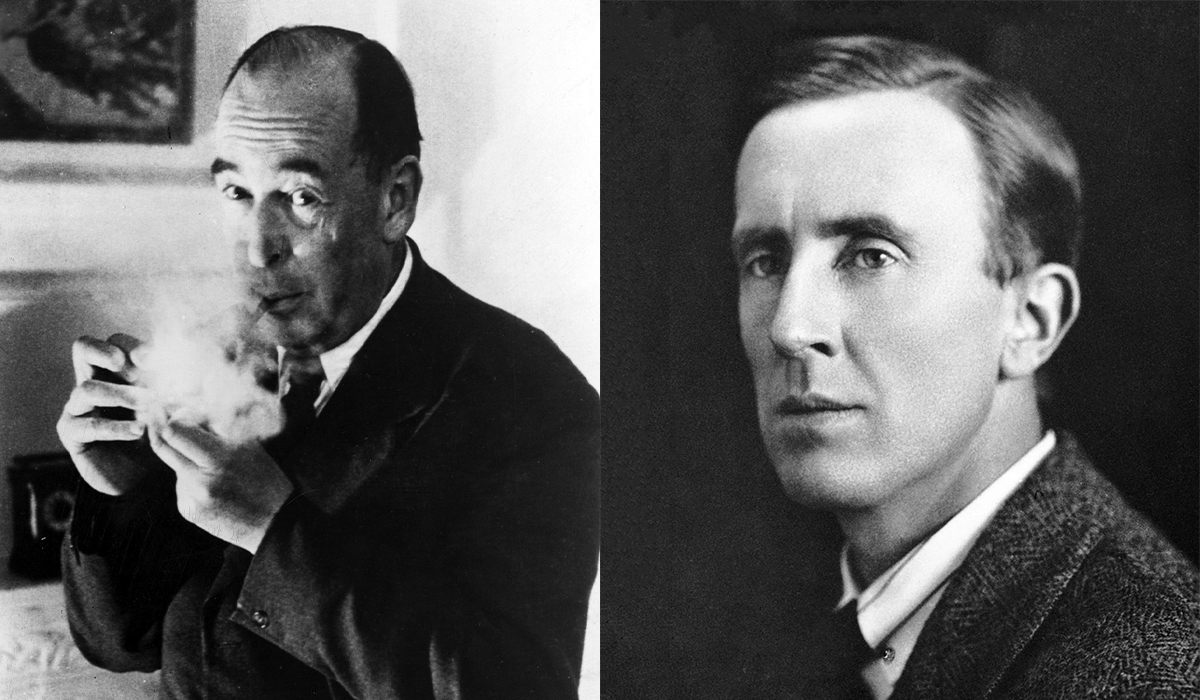
100 Years of Lewis & Tolkien: The Day Fantasy Changed Forever
Oxford, a Tuesday in May 1926. Within the venerable halls of Merton College, two men met who could hardly have been more different. One was a self-proclaimed atheist, the other a devout Catholic. Yet their shared passion for language and fantasy brought them together—and changed the fantasy genre forever. How lucky we are that J.R.R. Tolkien and C.S. Lewis sat down for a cup of tea together 100 years ago!
Not Exactly Love at First Sight
We like to imagine this meeting as something magical, accompanied by fanfares and loads of hugs. The reality, however, was quite different. In fact, Lewis noted in his diary that Tolkien was a "smooth, pale, fluent little chap" who "only needs a smack or so". Diana Pavlac Glyer captures the difficult circumstances perfectly in her book Bandersnatch: C.S. Lewis, J.R.R. Tolkien, and the Creative Collaboration of the Inklings:
“As Lewis and Tolkien got to know each other, it became clear that they had a number of serious disagreements. They had different interests and personalities. They came from different religious traditions. And they had different academic specialties. Lewis said that meeting Tolkien triggered two of his childhood prejudices. He explains, ‘At my first coming into the world I had been (implicitly) warned never to trust a [Catholic], and at my first coming into the English Faculty (explicitly) never to trust a philologist. Tolkien was both.’”
Despite this, the colleagues soon realized they shared a fervor for languages, poetry, myths, and stories, while simultaneously holding little interest in contemporary culture or politics. Furthermore, both harbored the ambition to become novelists.
The Inklings: Where Stories Were Forged
It is worth noting that these two didn't become inseparable friends simply because they liked making up stories. They were united by much more: both had lost their mothers at a young age, and both had experienced the horrors of the First World War firsthand. It is hardly surprising, then, that they felt such a strong pull toward imaginary worlds.
They lived out this passion through the Inklings, a legendary literary circle that included writers like Charles Williams or Owen Barfield alongside Lewis and Tolkien. The members met regularly at The Eagle and Child pub to philosophize, debate, and, most importantly, read their unpublished works aloud to gather feedback.
For us fantasy fans, both aspects are vital: the formal meetings of the Inklings and the deep personal friendship between Lewis and Tolkien. The two influenced each other more profoundly than anyone could have guessed back in May 1926.
No Middle-earth Without Lewis, No Narnia Without Tolkien
Through countless debates, Tolkien—the staunch Catholic—helped lead the atheist Lewis back to faith. He convinced him that myths were not "lies." Tolkien compared the story of Christ to the Norse sagas they both loved, with one key difference: according to Tolkien, the Christian myth was true. Whether you agree or not, this logic convinced Lewis, who later infused his Narnia books with heavy Christian symbolism.
Conversely, the perfectionist Tolkien might never have finished his epic, The Lord of the Rings, without Lewis. His children’s book The Hobbit had been out for a while, and the publisher George Allen & Unwin was eager for a sequel. However, the other Inklings weren't exactly sold on Tolkien's follow-up; Hugo Dyson, in particular, was known to complain loudly during readings. Only Lewis emerged as a true champion, cheering his friend on: "It is a book that will break your heart."
Tolkien later wrote: “The unpayable debt that I owe to him was not ‘influence’ as it is ordinarily understood, but sheer encouragement. He was for long my only audience. Only from him [did I] ever get the idea that my ‘stuff’ could be more than a private hobby.”
The Breaking of the Fellowship
As much as we celebrate the greatest "bromance" in literary history, even this friendship had its trials, especially in later years. While Tolkien had led his friend back to faith, Lewis joined what Tolkien considered the "wrong" church—the Anglican one, to be precise. Tolkien also took issue with Lewis marrying a divorced American woman.
Over time, they saw each other less frequently; Tolkien once described Lewis as his "closest friend from 1927 to 1940." Yet, their bond never simply vanished. In 1949, Lewis wrote about how much he missed his friend. And upon Lewis's death, Tolkien compared the loss to the force of an "axe-blow."
A Lasting Legacy
Even if Tolkien and Lewis weren't "BFFs" but rather "BFs" for a season, they together founded and forever shaped the modern fantasy genre. Imagine if they hadn't met on May 11, 1926. We would have no Hobbits and no Aslan; no Middle-earth and no Narnia. There would be no blueprint for Game of Thrones or Dungeons & Dragons. Hell, there would be no Elbenwald! Simply put: our popular culture would be infinitely poorer.
And now for some Fun Facts!
- The character of the Professor in The Lion, the Witch and the Wardrobe is often compared to Tolkien.
- Conversely, the character of Treebeard was inspired by Lewis's booming voice and mannerisms!
- In 1961, Lewis nominated his friend Tolkien for the Nobel Prize in Literature, though sadly without success
- As much as Lewis loved Middle-earth, Tolkien actually disliked Narnia because he felt Lewis threw too many disparate mythologies together into a "mishmash."